\(\varepsilon' < 0\): the wave cannot enter → reflection (metals)
Today's question
We used ε(ω) as a given number. But where does it come from? Why is it different for glass, dye and gold — and why does it change with frequency?
Short answer
From how electrons move when the light field pushes them. We will model that motion with Newton's law.
Roadmap
Today's logic: from one electron to what we see
Electron motionNewton's law, x(t)
→
Dipolep = −e x
→
PolarizationP = N p
→
ε(ω)D = ε₀εE
→
n, κlecture 1
→
What we seecolor, gloss, rainbow
By the end of this lecture you can…
write and solve the equation of motion of a driven, damped, bound electron;
derive the Lorentz dielectric function \(\varepsilon(\omega) = 1 + \dfrac{\omega_p^2}{\omega_0^2 - \omega^2 - i\gamma\omega}\);
sketch ε′, ε″, n and κ versus frequency and explain each region physically;
explain why glass is transparent, why prisms make rainbows, and why dyes are colored.
The model
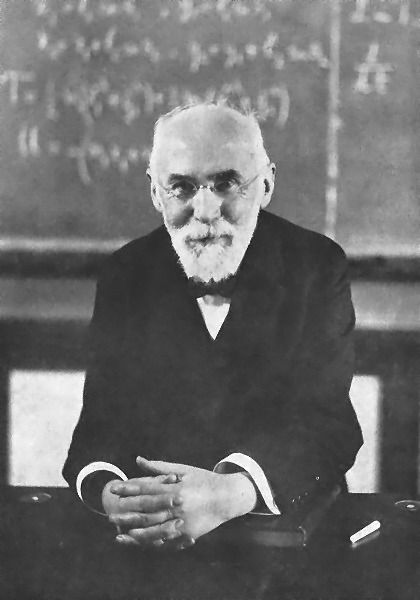
Lorentz's idea: an electron held by a spring
Hendrik A. Lorentz (1853–1928) Museum Boerhaave · public domain
Nobel Prize 1902. Explained optical properties of matter with bound electrons — before quantum mechanics.
Spring
restoring force \(-m\omega_0^2 x\) natural frequency \(\omega_0\)
Damping
friction force \(-m\gamma\dot{x}\) energy loss rate \(\gamma\)
Driving
light's force \(-eE_0e^{-i\omega t}\) at frequency \(\omega\)
Derivation · why a spring?
Why does a bound electron act like a spring?
Physical meaning
Ordinary atoms resonate in the ultraviolet. Visible light (1.8–3.1 eV) drives them far below resonance — that is why glass, water and air are transparent but absorb UV.
1
Charge density of the cloud (charge ÷ volume):\[ \rho = \frac{-e}{\tfrac{4}{3}\pi a^3} \]
2
Gauss's law on a sphere of radius r < a — only the charge inside r counts:\[ E(r)\,4\pi r^2 = \frac{\rho\,\tfrac43\pi r^3}{\varepsilon_0} \;\Rightarrow\; E(r) = \frac{\rho\,r}{3\varepsilon_0} = \frac{-e\,r}{4\pi\varepsilon_0 a^3} \]
The field grows linearly with r inside a uniform ball.
3
Force on the nucleus at r = x (the cloud feels the opposite force):\[ F = eE(x) = -\underbrace{\frac{e^2}{4\pi\varepsilon_0 a^3}}_{k}\,x \]
F = −kx: exactly Hooke's law. So \(m\omega_0^2 = k\).
Pulls the electron back to equilibrium. Alone, it gives free oscillation at \(\omega_0\).
Damping term
Proportional to velocity. Represents collisions and radiation. The energy decays in a time \(1/\gamma\); the amplitude decays as \(e^{-\gamma t/2}\).
Driving term
The electric field of light at the atom. The atom (0.1 nm) ≪ λ (500 nm), so E is uniform over it.
We ignore the magnetic force: it is smaller by v/c, which is tiny for an electron driven by ordinary light.
Derivation · step 2
Solve it: guess, differentiate, substitute
1
Guess. After the start-up transients die out, the electron oscillates at the drive frequency:\[ x(t) = x_0\,e^{-i\omega t} \]
x₀ is a complex number: it stores both the size and the timing (phase) of the motion.
2
Differentiate. Each time derivative just multiplies by −iω:\[ \dot x = -i\omega\,x, \qquad \ddot x = (-i\omega)^2 x = -\omega^2 x \]
3
Substitute and divide by \(m\,e^{-i\omega t}\) — the time dependence cancels:\[ -\omega^2 x_0 = -\omega_0^2 x_0 + i\gamma\omega\,x_0 - \frac{e}{m}E_0 \]
4
Collect x₀ on the left and solve:\[ (\omega_0^2 - \omega^2 - i\gamma\omega)\,x_0 = -\frac{e}{m}E_0 \;\Rightarrow\; x_0 = \frac{-e/m}{\omega_0^2 - \omega^2 - i\gamma\omega}\,E_0 \]
Why the complex trick works
The equation is linear, so the real part of a complex solution is a real solution. And \(e^{-i\omega t}\) keeps its shape when differentiated — calculus becomes algebra.
Sanity check ✓
Static field (ω = 0): \(x_0 = -eE_0/(m\omega_0^2)\) = force ÷ spring constant. A spring stretched by a constant force, exactly as expected.
Physical meaning
Everything interesting lives in the denominator \(D = \omega_0^2 - \omega^2 - i\gamma\omega\): it decides how far and how late the electron moves.
Derivation · reading the answer
Reading the denominator: amplitude and phase lag
Physical meaning
Near ω₀ the real part vanishes: |D| becomes tiny (→ huge amplitude) and the arrow points straight down (φ = 90°).
1
Write D as length × direction (polar form):\[ D = |D|\,e^{-i\phi},\quad |D| = \sqrt{(\omega_0^2-\omega^2)^2 + \gamma^2\omega^2},\quad \tan\phi = \frac{\gamma\omega}{\omega_0^2-\omega^2} \]
2
Divide: \(1/D = e^{+i\phi}/|D|\). With the force amplitude \(F_0 = -eE_0\):\[ x_0 = \frac{F_0/m}{|D|}\,e^{i\phi} \]
3
Take the real part to get the physical motion:\[ x(t) = \operatorname{Re}\!\left[x_0e^{-i\omega t}\right] = \frac{F_0/m}{|D|}\,\cos(\omega t - \phi) \]
The force is \(F_0\cos\omega t\); the electron follows it with amplitude \(\tfrac{F_0/m}{|D|}\), delayed by the phase φ.
Physical meaning
Slow, resonant and fast driving: amplitude and phase
ω ≪ ω₀ · in phase
Small motion, follows the force. The spring dominates.
ω = ω₀ · 90° behind
Huge motion. Velocity is in phase with the force → maximum energy transfer.
ω ≫ ω₀ · opposite
Small motion, 180° out of phase. Inertia (mass) dominates.
Derivation · step 3
From one electron to ε(ω)
1
One dipole. Charge times displacement, \(p = -e\,x_0\):\[ p = -e\cdot\frac{-e/m}{D}\,E_0 = \frac{e^2/m}{D}\,E_0 \]
Two minus signs cancel: below resonance (D > 0) the dipole points along E.
2
Many dipoles. N atoms per volume, all driven the same way:\[ P = N p = \frac{N e^2/m}{D}\,E_0 \]
Using the macroscopic E is valid for a dilute medium (gases). Dense solids need the local field (Clausius–Mossotti / Lorentz–Lorenz).
3
Definition of ε. From \(D_{\text{field}} = \varepsilon_0E + P = \varepsilon_0\varepsilon E\) we get \(\varepsilon = 1 + \dfrac{P}{\varepsilon_0E}\):\[ \varepsilon(\omega) = 1 + \frac{N e^2}{\varepsilon_0 m}\cdot\frac{1}{\omega_0^2 - \omega^2 - i\gamma\omega} \]
\[ \omega_p^2 = \frac{N e^2}{\varepsilon_0 m} \]Plasma frequency: grows with the number of electrons N. It sets the strength of the response, and will be the star of lecture 3.
Math tool. To remove i from a denominator, multiply by the complex conjugate:\[ \frac{1}{a - ib} = \frac{a + ib}{(a-ib)(a+ib)} = \frac{a + ib}{a^2 + b^2} \]
2
Apply it with \(a = \omega_0^2-\omega^2\) and \(b = \gamma\omega\):\[ \varepsilon = 1 + \omega_p^2\,\frac{(\omega_0^2-\omega^2) + i\gamma\omega}{(\omega_0^2-\omega^2)^2 + \gamma^2\omega^2} \]
3
Read off the real and imaginary parts:\[ \varepsilon' = 1 + \frac{\omega_p^2\,(\omega_0^2-\omega^2)}{(\omega_0^2-\omega^2)^2 + \gamma^2\omega^2}, \qquad \varepsilon'' = \frac{\omega_p^2\,\gamma\omega}{(\omega_0^2-\omega^2)^2 + \gamma^2\omega^2} \]
Read ε′ (numerator a = ω₀² − ω²)
Below ω₀: electron in phase → adds to ε. Above ω₀: out of phase → subtracts; ε′ can become negative.
Read ε″ (numerator b = γω)
Always ≥ 0 and ∝ γ: no damping, no absorption. Large only where the denominator is small — near ω₀.
Physical meaning
The phase lag φ of the electron decides the sign of ε′. Damping γ alone creates ε″.
Physical meaning
ε′ and ε″ across the resonance: four regions
A · below resonance
ε′ > 1, ε″ ≈ 0. Transparent; n rises with ω (normal dispersion).
Result — a Lorentzian, with peak value \(\omega_p^2/\gamma\omega_0\) at ω = ω₀:\[ \varepsilon'' \approx \frac{\omega_p^2}{2\omega_0}\cdot\frac{\gamma/2}{(\omega - \omega_0)^2 + (\gamma/2)^2} \]
4
Width. Half of the peak when \((\omega-\omega_0)^2 = (\gamma/2)^2\), i.e. ω = ω₀ ± γ/2:\(\quad\Delta\omega_{\text{FWHM}} = \gamma\)
Physical meaning
Linewidth ↔ lifetime: an oscillation whose energy dies out in τ = 1/γ (amplitude ∝ e−γt/2) has a spectrum of width γ (FWHM). Short-lived resonances are broad. Plasmons live ~10 fs → broad peaks (week 9).
Derivation · energy
Why ε″ means absorption: the power taken from the light
Power per volume is J·E. For two phasors, the average over one cycle is\[ \langle \mathbf{J}\cdot\mathbf{E}\rangle = \tfrac12\operatorname{Re}\!\left(\mathbf{J}^{*}\!\cdot\mathbf{E}\right) \]
Far from resonance γ is negligible, and \(\sqrt{1+\chi}\approx 1+\chi/2\):\[ n - 1 \approx \frac{\omega_p^2}{2(\omega_0^2 - \omega^2)} \approx 1.6\times10^{-4} \]
Compare with measurement
model: n − 1 ≈ 1.6 × 10⁻⁴ measured (20 °C): n − 1 ≈ 2.7 × 10⁻⁴
Physical meaning
Right order of magnitude from a spring model with no fitting! Real molecules have several electrons and several resonances — the full theory sums over them (next slide).
Both resonances are far away. n is nearly constant but rises toward the UV resonance:\[ n(\lambda) \approx A + \frac{B}{\lambda^2} \]Cauchy's formula — blue light bends more than red.
Physical meaning
Transparency is not "no interaction": it is being between resonances.
Note: P = N p with the macroscopic E holds for dilute media (gases). In dense glass the local field matters (Clausius–Mossotti / Lorentz–Lorenz).
Application · dispersion
Dispersion in action: prisms, rainbows and optical fibers
Prism: n(blue) > n(red) D-Kuru · CC BY-SA 3.0 ATRainbow: dispersion in water droplets Eric Rolph · CC BY-SA 2.5Fibers: colors travel at different speeds Tulumnes · CC BY-SA 4.0
All three come from region A of the Lorentz model: n increases toward the UV resonance.
Application · color
Color by absorption: resonances inside the visible
Food colorings — TaurusEmerald · CC BY-SA 4.0Ruby crystal — W.carter · CC BY 4.0
Complementary color
A molecule with ω₀ in the green absorbs green; the transmitted light looks magenta/red. Dyes, chlorophyll and ruby all work this way — large molecules and crystal ions have resonances at 2–3 eV, not 10 eV.
Link to plasmonics
A gold nanoparticle is also a resonator in the green. The Lycurgus Cup red is the same logic — but the "spring" is the particle's surface charge (lecture 9).
Deeper idea · causality
ε′ and ε″ are not independent: Kramers–Kronig relations
\(\mathcal{P}\): principal value. (A similar formula gives ε″ from ε′.) We will not derive it — just understand it.
Why? Causality.
The electron cannot respond before the field arrives. This single fact forces the real and imaginary parts of any response function to be linked.
What it tells us
Absorption somewhere ⇒ dispersion everywhere.
If ε″ = 0 at all frequencies, then ε′ = 1 at all frequencies: any refraction requires absorption somewhere.
Classic method: measure reflectance over a broad spectrum and compute the phase with Kramers–Kronig (e.g. Ehrenreich & Philipp 1962). Johnson & Christy instead inverted reflection and transmission of thin films; today ellipsometry is common.
Check with the Lorentz model
Our ε(ω) satisfies Kramers–Kronig automatically: the peak in ε″ comes with the S-shaped wiggle in ε′.
With ω₀ = 0, region C (ε′ < 0) stretches from zero frequency up to ωp ≈ 9 eV, the free-electron value for gold and silver. Bound electrons lower the real zero crossing (gold ≈ 2.9 eV, silver ≈ 3.8 eV; next lecture), but metals still reflect visible light. That is why metals are shiny.
Check your understanding · click a card to reveal
Concept check
Q1. At resonance, what is the phase between the electron's displacement and the driving force? Why does this maximize absorption?
90° lag: velocity is in phase with the force, so the force does maximum work each cycle.
Q2. If γ doubles, what happens to the height and width of the ε″ peak?
Width doubles (FWHM = γ); peak height ∝ 1/γ, so it halves. Area stays about the same.
Q3. Why does blue light bend more than red light in glass?
Blue is closer to the UV resonance → larger ε′ → larger n (normal dispersion).
Q4. In which region of the Lorentz model does a material behave like a mirror, and why?
Region C, just above ω₀: electrons lag the force by 180°, so the dipoles point against E and outweigh ε₀E → ε′ < 0, light cannot enter → strong reflection.
Wrap-up
Summary and homework
1
Bound electron = driven, damped spring: \(m\ddot x = -m\omega_0^2x - m\gamma\dot x - eE\).
2
\(\varepsilon(\omega) = 1 + \dfrac{\omega_p^2}{\omega_0^2-\omega^2-i\gamma\omega}\), with \(\omega_p^2 = Ne^2/\varepsilon_0 m\).
3
Phase lag decides the sign of ε′; ε″ (absorption) peaks at ω₀ with width γ.